Showing posts with label Judgments. Show all posts

March 9, 2017

Settlement Agreements


When given the opportunity to be certain in a litigated matter, it is typically prudent to opt for such a route. This can eliminate future uncertainty. In a recent unpublished appellate opinion, the parties unfortunately decided against such a route and further litigation ensued.

Lough v. Lough, Orange County Superior Court Case #
30-2011-00507232


The central issue stemmed from the interpretation of a settlement agreement.

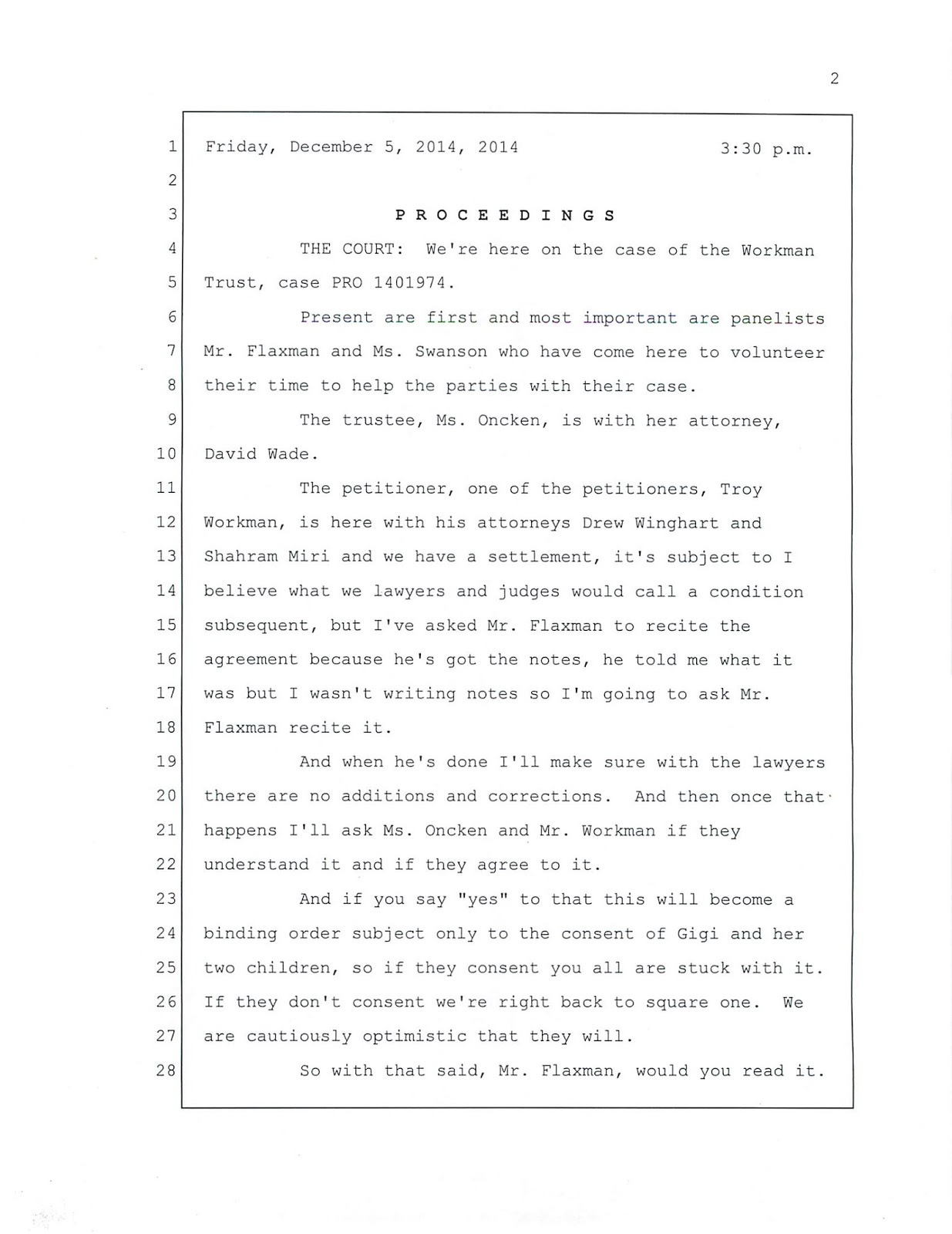
"In May 2008, on the eve of the trial of the underlying action, Vinetta, Rodger, and Richard reached a settlement (the settlement agreement) after discussions in the chambers of Judge Di Loreto, the trial judge assigned to the case. The terms of the settlement agreement were put on the record in court with all parties present."

"Judge Di Loreto emphasized that the settlement agreement that was being put on the record was a binding agreement, stating that "basically what we're doing today is, in fact, a settlement, we're going to put it on the record. Even though nobody signed anything, it's just as good. [¶] [The court reporter] is taking down everything that I say, so it's going to be part of a settlement that's going to be enforceable. Do you understand?" Vinetta responded, "Yes." Judge Di Loreto asked Vinetta, "Do you understand everything Ms. Lough?" Vinetta responded, "I should." Judge Di Loreto said, "Well, not you should, do you understand it?" Vinetta responded, "I do." Judge Di Loreto then asked, "Do you agree to it?" Vinetta responded, "Yeah."

"The court ordered that copies of the transcript of the hearing be provided to counsel for both sides "so they can draft the stipulation, even though at this point in time we have it on the record so it's binding, even though it's not reduced to writing but it should be reduced to writing." Vinetta's counsel told the court that he would reduce the settlement agreement to writing within two weeks. The court responded, "So if I continue this matter until, say, May 16th, you'll be able to come in here with something to have formally in writing so I won't have to look to the court reporter every time?" Vinetta's counsel replied, "That would certainly be my client's desire, Your Honor. I will do everything to make that happen." In a declaration prepared in September 2013 in support of a motion by Rodger for summary adjudication in the present case, Vinetta's former counsel stated: "Ultimately, it was agreed between me and counsel for Richard that as between Vinetta, on the one hand, and Richard and Rodger, on the other hand, the May 5, 2008, transcript would stand on its own and we would not draft a separate settlement agreement. However, we did agree that a judgment would be entered to effectuate the terms of the settlement with respect to the four properties that Vinetta was going to retain and to confirm that Vinetta held title to those properties free and clear of any claims or interests of Richard (or Rodger)." (emphasis added).  

Following Vinetta's death, Richard filed suit against Rodger to enforce the settlement agreement. 

January 13, 2017

Spendthrift Clause and Creditors


A common, albeit erroneous, legal assumption is that a beneficiary's interest in a trust with a spendthrift clause is bullet-proof. That is, the beneficiary's interest cannot be attached by a third-party so as to prevent the beneficiary from enjoying the full benefits of the trust. In certain circumstances, however, a third-party can attach a beneficiary's interest in a trust and direct payments to be made to them and not the beneficiary. A recent unpublished appellate opinion highlighted this example.

Power v. Power, Sonoma County Superior Court, Case # SCV252844

Estranged husband was a 1/6 beneficiary of a trust established by his mother. The trust contained a spendthrift clause. It read in pertinent part that the beneficiary "cannot anticipate, assign or encumber the beneficiary's interest in income or principal. Similarly, a creditor of a beneficiary cannot subject the beneficiary's interest in income or principal to the creditor's claims or to legal process before the beneficiary actually receives a distribution." 

Estranged wife obtained a spousal support judgment against estranged husband. She then sought to attach estranged husband's interest in the trust to satisfy her judgment. The co-trustees balked and estranged wife sued to compel payment from them.

Since estranged wife had a support judgment, she could avail herself of Probate Code § 15305. The statute provides that a support judgment creditor may, under certain circumstances, attach a beneficiary's interest in a trust. The relevant section reads "whether or not the beneficiary has the right under the trust to compel the trustee to pay income or principal or both to or for the benefit of the beneficiary, the court may, to the extent that the court determines it is equitable and reasonable under the circumstances of the particular case, order the trustee to satisfy all or part of the support judgment out of all or part of future payments that the trustee, pursuant to the exercise of the trustee’s discretion, determines to make to or for the benefit of the beneficiary." Probate Code § 15305(c).

The trial court found that the "none of Mark's creditors that have been paid directly from the Trust are preferred or secured creditors. For the most part, these debts are owed to the limited partnership and the Trustees have scrupulously seen to it that Mark pays his debts to his birth family, while leaving Patricia with no funds." It should be noted that the trustees feared reprisal from the estranged husband who threatened to sue them if they paid even "one dollar" to his estranged wife. Hence, it was not as if the trustees refused to satisfy the support judgment whimsically.

On appeal, the trial court's decision to have the co-trustees pay the support judgment directly from estranged husband's share of the trust was upheld.

February 18, 2015

Following a Court Order


A sure-fire way to get into a legal predicament is to disobey a court order. Failure to abide by a court order is grounds for dismissal of an appeal. The term for this is the disentitlement doctrine. This legal remedy was recently applied in an unpublished opinion involving a misbehaving party from San Bernardino County Superior Court. Blumberg v. Minthorne, Case # PRODS1000744.

Following a bench trial pertaining to a probate matter, a judge ordered the petitioner to file an accounting by a certain date and quit-claim a property to her step-grandson. She failed to do either and in the meantime, filed an appeal. Her appeal was then dismissed because of her inability to comply with both aspects of  the court order. In light of the opinion, it is not hard to see how she failed to comply.

In regards to quit-claiming the property to her step-grandson, the opinion states:

"The second issue is the conveyance of the property. Gloria's conduct with respect to this issue is, to put it bluntly, despicable. She was ordered to quitclaim the property to Adam. She failed to do so. The court set an OSC. On the same day she filed an opposition to the OSC, she recorded a quitclaim to her daughter at 4:10 in the afternoon. The opposition does not mention this, instead suggesting a number of options in lieu of quitclaiming the property to Adam, including staying the transfer, appointing a neutral trustee, or staying transfer upon a reasonable bond. She was utterly dishonest with the court."

In a nutshell, the petitioner was supposed to transfer the property to her step-grandson. Instead she transfers the property to her daughter. Hmmmm.

For reference, "OSC" stands for "order to show cause." This hearing is typically scheduled when something has gone awry in a case and the court needs a status update. If a party has not conducted themselves appropriately, sanctions can be assessed (monetary penalties).

Naturally, the appellate court did not look kindly upon the petitioner's appeal:

"Gloria's conduct since the judgment has frustrated the attempts of the court to legitimately effect its own orders. She has missed court dates, failed to keep her own promises, lacked candor in her communications with the court, and ignored the court's orders. She cannot therefore now seek relief from the appellate court. The disentitlement doctrine applies."

The court of appeal then, not surprisingly, dismissed her appeal.

December 4, 2009

Probate Creditor Claims


The following is an overview of who gets priority when satisfying a decedent's debt during probate. 


1. Administration expenses—for obligations secured by a mortgage, deed of trust, or other lien, only the administration expenses that are reasonably related to the administration of the secured property are given priority (Prob C §11420(a)(1));

2. Obligations secured by a mortgage, deed of trust, or other lien, including a judgment lien, to the extent that they can be paid out of the property subject to the lien—if the property is insufficient, the unsatisfied obligation is a general debt (Prob C §11420(a)(2));

3. Funeral expenses (Prob C §11420(a)(3));

4. Expenses of last illness (Prob C §11420(a)(4));

5. Family allowance (Prob C §11420(a)(5));

6. Wage claims (Prob C §11420(a)(6)); and

7. General debts (Prob C §11420(a)(7)).